
Nine African cities ranked in IMD Smart City Index 2026
No African city breaks into the global top 100, but the gap is narrowing

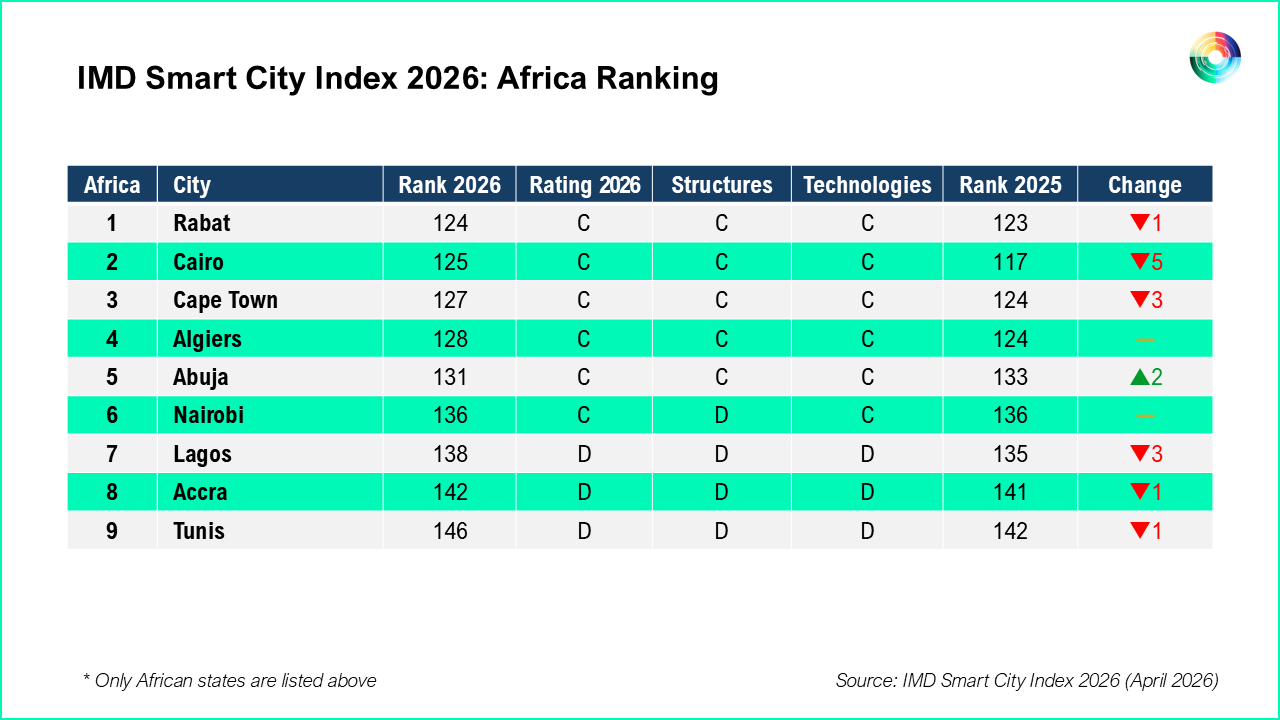
#Africa #SmartCities – Nine African cities feature in the IMD Smart City Index 2026, published by Swiss business school IMD across 148 cities worldwide, although none rank inside the global top 100. Morocco’s capital Rabat leads the African table at 124th globally, followed by Cairo at 125th and Cape Town at 127th. The results reveal a consistent pattern across African cities: technology scores frequently outpace governance and institutional structures scores, the inverse of what the index identifies as the formula for top-performing smart cities globally. Abuja is the only African city to improve its position year-on-year, rising two places to 131st.
SO WHAT? – The IMD index’s central finding this year, that strong institutions predict smart city performance more reliably than technology investment, is particularly relevant for Africa. Several African cities score reasonably well on technology indicators but lag on governance, transparency, and citizen trust. That structural gap cannot be closed by infrastructure spending alone. For African policymakers, the index is less a technology diagnostic and more a governance scorecard.
Here are some key facts and figures from the Smart City Index:
Nine African cities rank in this year’s IMD Smart City Index, out of a total of 148 cities worldwide. The index, published by Swiss business school IMD, measures how residents experience urban technology, infrastructure, and governance.
Rabat ranks first in Africa at 124th globally, rated C across both Structures and Technology pillars. Morocco’s capital has pursued a governance-led smart city strategy since 2019 through its Rabat Smart and Sustainable City initiative, combining digitisation of municipal services with citizen participation frameworks and sustainability investment.
Cairo is placed second in Africa at 125th globally, also rated C across both pillars. Egypt’s smart city strategy is anchored in its Vision 2030 framework, with investments in nationwide fibre-optic networks, IoT systems, and the flagship New Capital: a purpose-built smart city district being built from the ground up to global standards.
In third place among the African cities listed is Cape Town (127th globally), rated C across both pillars. South Africa’s legislative capital takes a pragmatic approach to smart city development, focusing on AI-enabled public safety systems, open data governance, and digital inclusion under its Thriving City 2050 vision.
Algiers is placed fourth in Africa at 128th globally, rated C on Structures but D on Technology. The Algerian capital’s smart city strategy, initiated around 2017, centres on local talent development and ecosystem building, with priority areas including intelligent transport, energy optimisation, and regulatory sandboxes.
Nigeria’s city of Abuja is the only African city to improve its global ranking in 2026, rising two places to 131st. The federal capital is pursuing a large-scale infrastructure-led transformation. Meanwhile, the 841-hectare Abuja Midtown smart district, backed by multi-billion dollar private investment and international partnerships including Japan’s JICA agency.
Nairobi ranks sixth in Africa at 136th globally, rated C on Technology but D on Structures. Kenya’s capital scores relatively well on digital infrastructure and innovation ecosystem indicators, but institutional and governance scores remain a constraint on its overall ranking.
Lagos, Accra, and Tunis occupy the bottom three African positions, ranking 138th, 142nd, and 146th globally respectively, all rated D across both pillars. All three cities slipped compared to their 2025 positions. Tunis recorded the lowest Structures score among African cities, at a factor average of 36.1.
Four of the nine African cities in the index are in North Africa: Rabat, Cairo, Algiers, and Tunis. The placement reflects the region’s relatively higher levels of digital infrastructure investment and institutional development compared to sub-Saharan peers. Sub-Saharan Africa’s highest-placed city remains Cape Town.
Across all nine African cities, the index highlights a recurring pattern: technology adoption is outpacing institutional capacity and citizen trust. The IMD report notes that cities with higher Technology scores than Structures scores, the profile of most bottom-ranked cities globally, consistently underperform against citizen expectations.
ZOOM OUT – Rabat's position as the top-ranked African smart city in the IMD Smart City Index 2026 reflects a sustained national commitment to urban digital transformation. Morocco's smart city programme extends well beyond the capital. Casablanca, the country's commercial hub, has deployed AI-driven traffic systems, digital governance platforms, and urban data analytics for pollution and waste management. Marrakech is advancing renewable energy adoption and low-emission urban design under its Green Marrakech initiative. Rabat itself hosts the Ville Verte eco-district, combining smart water systems, electric buses, and intelligent energy management. Morocco is also purposefully driving AI adoption and AI development across all regions. The new Jazari Institutes network aims to distribute digital infrastructure, nurture home-grown talent and cascade the AI Made in Morocco strategy across the country.
[Written and edited with the assistance of AI]
DOWNLOAD
Also see our sister site Middle East AI News:
Dubai, Abu Dhabi top Arab cities in IMD Smart City Index (Middle East AI News)