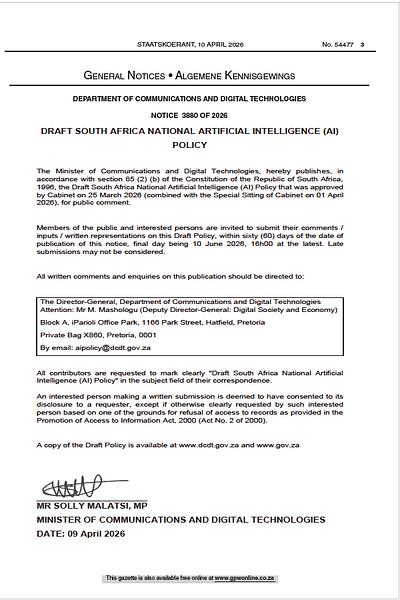
Deep Dive: the South African Draft AI Policy
Long on magical thinking, short on pragmatism

This is a long one... 8,500 words. That’s because the policy is 23,445 words long, and gets quite involved. For ease of digestion, Africa AI News has copied the text of the policy (in block quote) and then made comments. So the fastest way to read this doc is jump from comment to comment, and then go back and inspect the actual Draft National AI Policy content should you wish to.
If you’re short on time, here’s the tldr; version:
The policy is sound in structure and content, but rooted in three-year old thinking when the narrative then held that AI was an almost magical technology that would replace humans.
The core of the policy is driven by the assumption that AI can do what it claims - replace humans and operate autonomously
The policy does not seek to understand or mitigate against the consequences of AI technologies disrupting entire industries, national infrastructure priorities, labour markets and people’s lives now, and later, when it proves to not be capable of doing the job as promised
The policy takes a long time to get to “Human In the Middle” (HITM), and does not make HITM the core of legislation or regulation, implicitly accepting that AI systems can effectively perform tasks (analysis, automation) as well or better than humans entirely autonomously and without human supervision
The policy does not consider regulatory capture and undue influence on national policy by powerful technology companies (and the foreign governments that bat for them)
The policy does make a strong case that where applied correctly, and with a HITM oversight or supervision requirement, AI systems can be incredible productivity and data analysis tools, and provide powerful automation capabilities to improve efficiencies in delivery of services to people (financial, healthcare, food security, etc)
The policy does not seek to understand and mitigate against damage to industries vulnerable to unfair competition from (in particular) Generative AI technologies. Example: while fine art will be fine, jobbing graphic designers and other creative professionals are seeing their businesses tank as people use Gemini, ChatGPT and similar to DIY certain business services.
Where it all began
To start ... where did this policy come from? It has been years in the making, with a number of very smart and committed people and chatbots working overtime producing various studies, reports, white papers, and finally the draft policy doc.
So to start at the beginning — the 2023 AI National Government Summit Discussion Document. Because this is where the thinking and framing of this draft policy originated, and it shows.
One’s hackles should be raised at the get-go at the inclusion of Boston Consulting Group’s (BCG) definition of AI as “a field of computer science that aims to create machines or systems able to perform tasks that normally require human intelligence – tasks involving reasoning, learning, decision-making, or creativity”.
Boston Consulting has a grim track record of intensive background lobbying for its preferred outcomes, and of the drafting of policies and strategies for friendly officials in some of the most repressive regimes. Active participation of international advisories is a two-edged sword: bleeding-edge thinking underpinned by opaque corporate motivations, undermining public participation and transparency.
But being familiar with this preliminary work is important, as the flaws that make the AI Policy Document so flawed as to be unusable begin here.
Two plus years ago, this was the thinking going into the envisaged policy paper.
This plan envisages to create a better AI future use through the following:
Creation of policy and regulatory experiments
A set of positive goals for what South African society requires from AI
Management of negative AI impacts on society and industry
Building an understanding of the AI technological possibilities
Proving certainty to society on this rapidly evolving AI technology through flexibility and accommodation of skills, software, innovations, and applications.
So far, so good. This policy objective is key:
Proving certainty to society on this rapidly evolving AI technology.
“Proving certainty” must be read as a specific objective of the policy, with actions. “Proving certainty” involves looking for, gathering and generating information that can be validated and traced back to its sources for use in credible advice to citizens from government, and as inputs to regulations and legislation .
AI may affect society as a whole and the economy and other areas such as national security, politics, and culture, however the effect on the macroeconomic terrain is on:
Productivity growth
Labour market, and
Industrial concentration
This part is clear — there are many impacts, but the three red-card areas are noted: productivity from the workforce; the very people that make up the workforce; and where they will be working to earn a living, support their families.
The Discussion Document notes a bunch of stuff about governance frameworks, which ends with this:
At a continental level, particularly in Africa, there is a strong emphasis on AI supporting sustainable development goals (SDGs).
So at least in the 2023’s South African AI policy was looking to align with the UN and EU. SDGs are a four letter word in some demihemispheres.
Then things start heading south towards a concerning level of AI-boosterism (also known as “AI-accelerationism”):
AI has the potential to deliver more benefits to humanity than any new technology in the last century. This AI benefit is also matched by great global and human potential harms.
BCG indicates that “governments need to start looking to learning from the AI leaders when it comes to AI implementation. Many governments have begun to implement AI across various small-scale pilots. But they are still limited to experimentation, and few have achieved true AI at scale.”
Again with the BCG? “Any technology in the last century.” That would include everything since say 1900 that has had a genuine, massive and enduring impact on people’s lives. Because that’s what we care about in policy, right? People’s lives? Not, say, shareholder value?
The last hundred years has seen the vacuum cleaner, vacuum tube and washing machine (just squeaked in). We got antibiotics and vaccines. Those were pretty good. Rockets and the Space Age’s gift, satnav. The transistor that allowed cheap home appliances and the information age. The pill. The Internet. That led to some good stuff, eventually.
This bit of a throwaway factoid chart was dropped into the Discussion Document for local colour. It shows startups and how much they raised in 2019 ... one assumes the doc’s authors wanted to show inward capital leading up to 2023 (when this Discussion Document was published), that there was a boom in foreign direct investment.
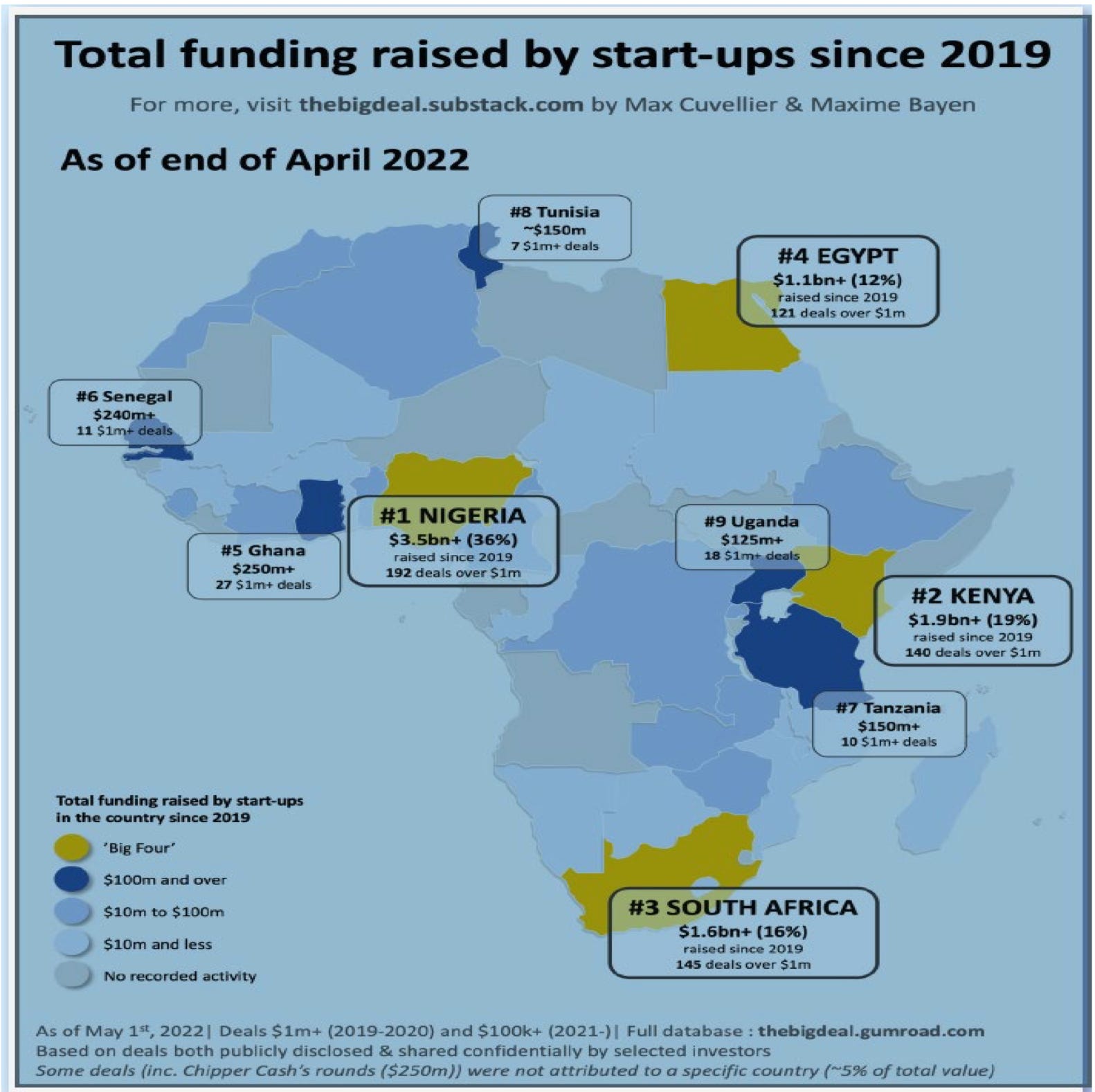
But if you go to the source, the report says: “March was overwhelmingly a debt month: of the $151m raised, $55m was equity and $96m was debt, meaning nearly two thirds of the month’s total came as debt. ... Exits were also busy in the background: we recorded five of them in March, all values undisclosed.”
Once you get over the size of the dollars being pumped in, the numbers above are actually not encouraging. Money was pouring into African startups. But it was largely debt. This was AI companies in Africa taking up a very big bag of rocks that they would regret carrying should things not work out. Most concerningly was a steady stream of VC exits, so selling the debt they’d bought to a new round of private equity bods, sovereign wealth fund proxies and other moneybags. Was it true investment, or was it a carousel of investment speculations to be ridden to an early cash-out, before the actual startup was actually growing to be worth something.
The bottom line: the naissance of the Discussion Document that led to the Draft AI Policy by the torturous path of departmental policy development, was fundamentally based on the premise that AI is almost magical level of awesome, and would drive massive economic growth and massive social transformation and the only way forward was to ride this bucking bronco to a grand future for humanity, and that there was no downside that made slowing things down or being a little circumspect a heresy only spoken by the tens of thousands of YouTube videos of subject matter experts.
The South Africa Natonal AI Policy — what’s it all about
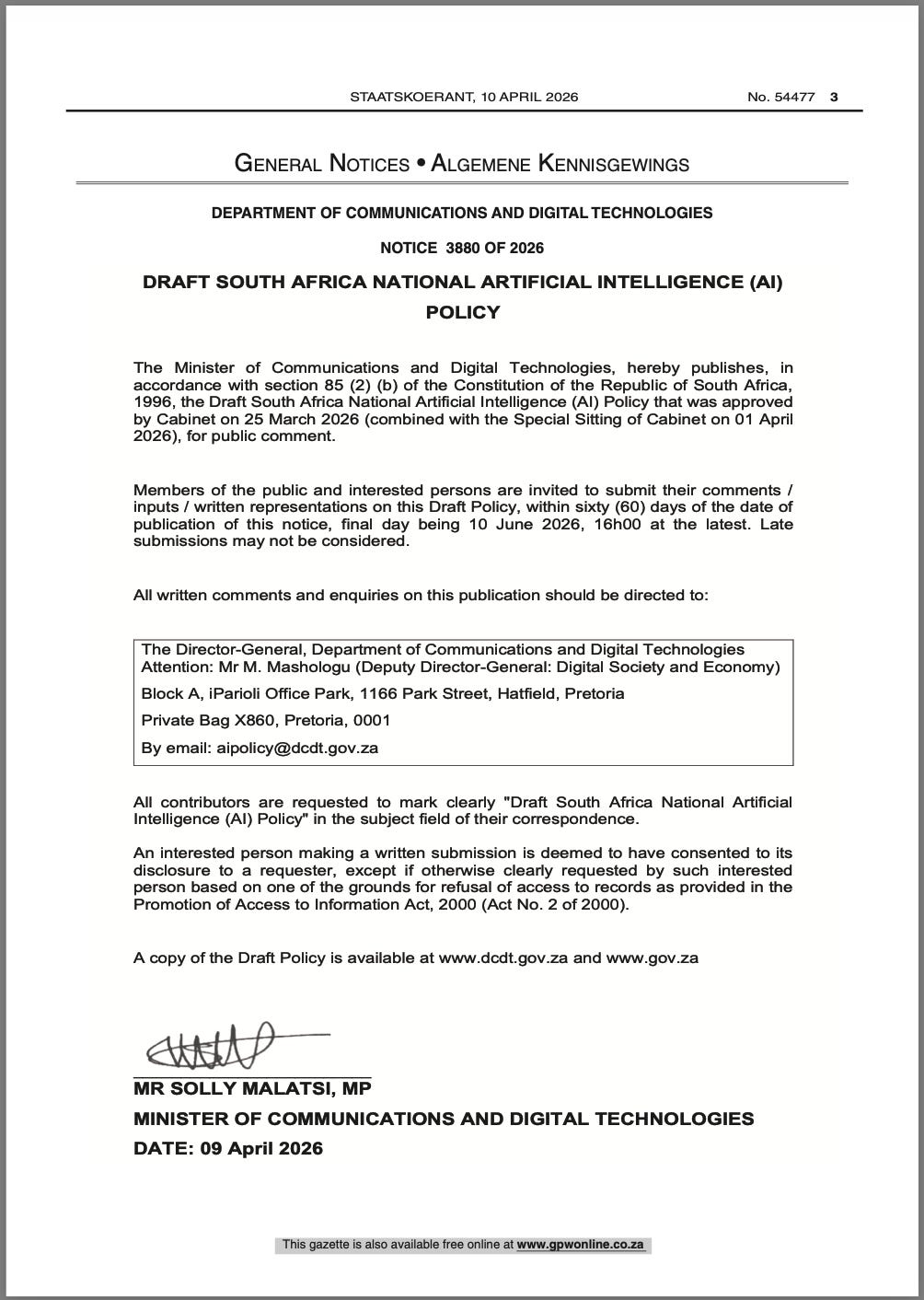
And then we come to the Draft South African National AI Policy of 2026.
Diving right in.
The Draft SA National AI Policy sets the tone well. It makes it clear that this is a draft policy, and not law or regulations.
Explanatory Note:
Setting a policy agenda for AI is inherently complex, as the technology has an immense range of applications. Because of the broad range of applications and applicability in almost every conceivable sector, a general national policy cannot, and should not, address every aspect of AI. Rather, a national policy’s primary objective is to identify the core principles that guide sectoral approaches.
Note: Sectoral approaches. This is government speak for “addressing named economic sectors”. The key here is policy interventions for specific sectors to help them work better with AI. Not to drive the AI industry.
The Draft National AI Policy is based on the South Africa National Artificial Intelligence Policy Framework of August 2024, the 32 submissions received on this Framework, and consultations with government structures through the Cabinet Cluster process.
The timeline looks almost creakingly slow:
1. Year 1 (2025/26):
a. Finalisation of the National AI Policy
b. Identification and publication of key draft regulatory requirements
necessary to address unacceptable risks
c. Initiate development of National AI Policy Guidelines
2. Year 2 (2026/27):
a. Publish National AI Policy Guidelines
b. Implement key regulatory requirements for high-risk use cases
c. Identify and publish draft regulatory requirements for medium and low risk AI use cases
d. Develop and adopt sectoral AI strategies
e. Commence institutional framework design and funding approach, and secure funding.
3. Year 3 (2027/28)
a. Full implementation of outstanding policy interventions, which may need to be updated to match emerging trends in AI technologies.
But... 2027 is only half a year away. We’re talking about going from a standing start to fully implemented in less time than it takes between Rugby World Cups.
This National Artificial Intelligence (AI) Policy document reflects our nation’s unwavering commitment to harnessing AI’s transformative power while addressing the specific needs of our society.
Important provisions address fairness, bias mitigation, and data sovereignty, recognizing South Africa’s socio-political landscape and the imperative to redress historical inequalities. The development of AI ombudsperson structures and the establishment of an AI Ethics Board underscore the importance of transparency, accountability, and human-centric AI deployment.
Sidenote: While industry ombuds in SA are reasonably well thought of, they are subject to industry capture, e.g. Short Term Insurance Ombud. So that is a pretty flimsy basket to be putting your regulatory eggs in. Moving on.
The expanded scope of this policy also introduces targeted interventions for capacity building and digital infrastructure enhancement. It outlines comprehensive educational initiatives to integrate AI into primary, secondary, and tertiary education, fostering a robust pipeline of talent to fuel innovation.
Additionally, the document highlights the creation of AI hubs and supercomputing facilities aimed at empowering local startups and small enterprises. These initiatives reflect a strategic shift toward democratizing access to AI technologies, ensuring that economic benefits are widely distributed across sectors and communities.
It is signed: Omega Shelembe, Acting Director General of the Department of Communications and Digital Technologies, on 9 April, 2026.
So what’s the problem?
Let’s dive right in, and start throwing rocks at the intro.
As a strategic general-purpose technology, AI holds the potential to drive innovation, enhance productivity, and contribute meaningfully to socio-economic development.
This is already problematic. It only looks at the up-side, and only at the up-side aggressively promised by tech vendors and management consultancies. Why is this a major flaw in the policy? Because it sets the entire tenor of the document... that AI is a wonderful wild stallion that just needs to be tamed to become a valuable beast of burden, wise guide and pleasant companion.
The policy goes on and on in this vein: “The rapid advancement of AI technologies globally and their transformative potential” ... but will they be transformative? Will they perhaps be merely useful, a productivity tool to extend our capabilities? What about the very real downsides, where AI is a vast suck of capital, attention and corporate malfeasance that makes it a a ticking time bomb that is actively confounding or destructive for our goals as people?
This is key — because most of the claims made about the powerful benefits are AI relate to productivity and profit growth for corporates. What about people? Will it make them happier? More fulfilled? Put food on the table, clothes on their backs, give them the luxury of art, travel and leisure? Will it educate their children?
Who is AI here to serve?
If South Africa’s AI policy is fundamentally drafted around the needs and wants of private capital, and unrestrained global capital, AI will not create a better future for people (other than shareholders).
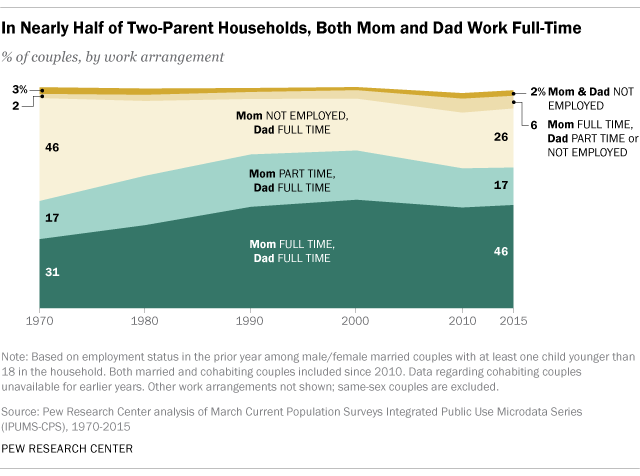
Remember how computers and tech introduced in the 50s and 60s would let us work three day weeks, and make goods and services cheaper? And yet today no modern family can survive on a single salary income, both parents work full time. The Internet boom in the 2000s was going to make us more efficient, work faster and more easily, and yet we’re online and available 24x7 even on weekends and holidays, in person in the office, and job security
While the number of hours worked per white-collar salaryman has (formally) been slowly improving at 160-175 hours per week since the 60’s. In fact today we work a lot less hours than the 20s America. they were clocking in 6 days a week, 200 hours. Except... now most middle class families, both parents work full time.
Fully half of all American families have both parents in a household working. There’s no useful stat for South Africa, but Google AI says 40-45%.
Back to the Draft Policy:
However, the pressure to harmonize with international standards and frameworks for ethical AI development and deployment underscores the necessity for robust and adaptive policymaking.
Sure, we need to stop AI systems being evil and terrible. But we also need to stop it being inadequate or useless, or misleading and distracting. Ooh! Shiny!
Policy interventions must bridge the gap between the push of technological advancement and the pull of economic transformation while addressing systemic inequalities. Investments in education, infrastructure, and inclusive governance frameworks will be critical to ensuring that AI not only drives economic growth but also contributes to social equity, sustainable development, and global leadership in ethical AI practices.
Ok, so putting government’s money where its mouths are. Investments in education, infrastructure and inclusive governance sounds like a good idea. The question is how much actual money will be spent, and value created between the three, if governance is already massively underfunded, especially compared to dominant countries (like the EU). A key here is that regulatory governance MUST be complied with, it’s the ticket to the game of international commerce. Will there be enough funding after setting up governance that can hold a candle to US, EU and Chinese regulatory environments, as well as to also build infrastructure, and develop educational materials and delivery?
A significant weakness of the AI policy is its maddening lack of clarity about key terms. What is “infrastructure”, because much of the time it sure sounds like datacentres and maybe also datacentres.
Public funding for high-risk corporate interests
Gargantuan datacentres are a cost of business of LLM operators, other AI technologies not so much. Datacentre build being funded from the public purse is a bum deal unless the access to it by the country’s researchers, startups, people is priced as a public good. It is not any governments business to be funding Azure’s datacentre build.
It’s imperative this AI Policy be very very clear what “infrastructure” means. Because if it’s datacentres, they will almost certain to be money-pits, when they’re not also actively damaging to the environment, driving down living standards, consuming vast amounts of often scarce water, putting overwhelming demands on the energy grid and driving up domestic electricity prices for households.
Perhaps the answer to data sovereignty and technology security does not lie in more datacentres, it lies in better data and smarter tools.
Why we need a strong, wise policy
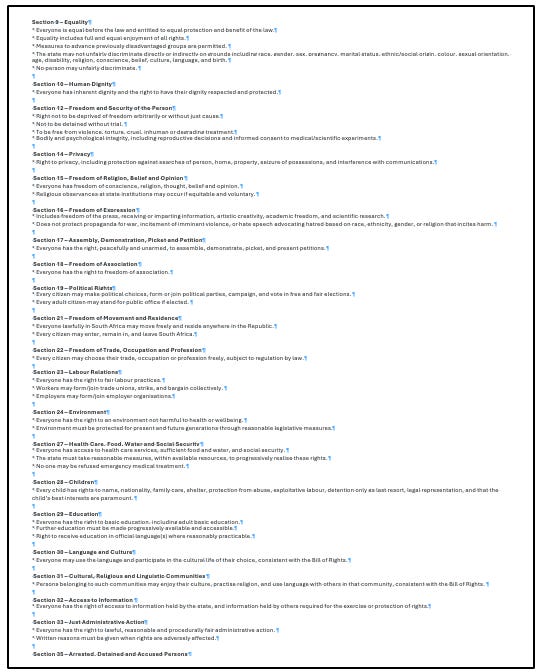
All these are in support of the provisions of the Constitution of the Republic, as well as the accompanying Bill of Rights. As a result, AI must not be used to violate any s9, s10, s12, s14, s15, s16, s17, s18, s19, s21, s22, s23, s24, s27, s28, s29, s30, s31, s32, s33, s35 rights. Instead, AI may be used to advance all these, as well as s11, s13, s20, s25, s26, s34 and any other rights.
Since no one knows what these parts of the South Africa Constitution are, here is a quick reference.
Go for a quick browse of it and then come back.
The Draft Policy mentions what else it’s got in the back of its head:
(The policy) also interfaces with continental and international frameworks such as the African Union (AU)
among(st) others. It also considers
the Smart Africa AI Blueprint
OECD AI Principles, and
UNESCO’s Recommendation on the Ethics of AI,
among(st sic) others. ... and the integration of insights from the PC4IR Report.
No, I haven’t read them. They’re linked so you can.
Right. Now we address the elephant in the room, the fundamental flaw in this Draft Policy Document.
AI is many things. Pick one.
The key to any policy, regulation, or law, is definition:
Artificial Intelligence (AI) is a multidisciplinary field that integrates principles from computer science, engineering, philosophy, psychology, mathematics, neuroscience, linguistics, and biology.1 Its primary goal is to develop intelligent agents capable of learning, modelling data, making predictions, and either autonomously making decisions or assisting humans in decision-making. While AI systems are inspired by human intelligence, they do not replicate it directly. Instead, AI aims to create machines that demonstrate reasoning, perception, learning, and adaptability in various contexts2.
1 Arias, C.R. (2022). An Introduction to Artificial Intelligence. SPU Works.
2 OECD (2020). Artificial Intelligence: How can we ensure that AI benefits society as a whole?
OK, so far so good. It goes on with the part where the rubber meets the road. What is AI, really, when you get right down to it?
AI can be defined as the combination of artificial (indicating non-natural) and intelligence (the ability to reason, perceive, learn, and generate insights).
And boom, there we have it. The Policy’s definition misses the one key aspect that makes intelligence intelligence, and not “really fast thinking”. The missing key aspect is:
...to reason, perceive, learn, and generate insights AND SELF CORRECT THROUGH INTUITIVE AND LOGICAL THINKING.
What makes us human, and wise, creative, empathic, resourceful and bold is not just our intelligence. It’s our lived experience, our contextual awareness, ability to evaluate from multiple angles simultaneously and our shared understanding of a common reality of being homo sapiens.
The things that separates us as people from powerful computer systems? Intuition, and self correction. And also learning from our mistakes (however imperfectly).
(Artificial Intelligence) encompasses activities such as speech recognition, problem-solving, planning, and adaptation to different environments.
Sure. AI can be good at the aspects above. Like the baggage handler robot at Japan Airlines. But just watch the video ... would you trust that robot to keep getting it right for more than five minutes unattended? All LLMs suffer the same fate if hit with a little too much novel input. It bombs out, acting erratically or flat out hallucinating (going mad).
The policy doc establishes that Machine Learning is a subset of AI, and arguably includes Neural Networks and decision tree models); and that Deep Learning is a sub-technology of Machine Learning using Artificial Neural Networks. Fine. Goddit.
It even acknowledges: Models like Decision Trees are better where “datasets are small or interpretability is crucial.”
This is really burying the lede once more. While the Draft Policy takes a nod at non-LLM based AI, it’s a very short nod. The only discussion at all of how we interact with AIs is addressed in three throw-away words: “interpretability is crucial”.
When we work with tools, we need to interpret what they are saying to us, how and why. We read a tyre pressure gauge, interpreting the scale, measurement metric and what the needle point means. We look at an income statement, and interpret the categorisation of expenses and revenues, the values of the items and currency they’re in.
LLMs sound like they’re human, and therefore we take them at their word. We do not feel we need to interpret their outputs. We don’t “interpret” because they sound like humans speaking. But we must interpret what an AI tells us. What is the LLM’s design? Where is it’s training data from? What model optimisations does it use? What corporate-driven decisions are in place in terms of guardrails, checks & balances? What are the price-related functionality or performance restrictions? What is its propensity to hallucinate?
There’s a bunch of major factors that radically change the outputs an AI provides, so we must be interpreting what it’s telling us. But we don’t... because they sound human. A major missing factor in the Draft AI Policy is discussion around how AI systems must give us information that allows us to reach an informed understanding of what we’re being told.
Policy vision
Proposed Policy Vision
3.1 Proposed National Vision emanating from the South Africa AI Policy “AI for inclusive economic growth, job creation, cost reduction, and a developing Africa.”
3.2 Critical Sectors for AI Implementation. AI in South Africa will play a key role in the critical areas of:
a. Education
b. Healthcare
c. And Agriculture
d. (With Public Administration implementation as a key lever or tool)
In all these sectors, the deployment of AI relies on robust digital infrastructure and widespread connectivity. A key rationale for establishing this policy is to foster sectoral strategies that address specific needs and opportunities within different industries, such as healthcare, education, security, finance, etc.
So... “we’re going to focus on just these three things, but also all the other things.”
They talk about the policy development framework in terms of:
Social Equity: Ensuring that AI contributes to social equity by addressing disparities and improving access to services is a key goal. AI can help bridge gaps in areas like healthcare, agriculture, education, and economic opportunities, promoting inclusiveness and reducing inequalities.
Sure. It COULD. But autonomous systems in government social programmes has been a series of poster children for broken decision-making. Like just happened in Sweden where kids are expected to fly like the crow to school, and not have to walk across bridges that may or may not exist within school commute walking distance.
The policy says it will “ensure that AI contributes to social equity”. That’s a big promise. How about adding “ensure that AI contributes to social equity, and investigate and remediate where it makes things worse”?
The body of the policy is built around the UNDP “Futures Triangle“ framework: “Policy must be designed to ensure that AI initiatives are inclusive and equitable, addressing historical disparities and promoting broad access to AI benefits”.
There is also a pressing need to protect people from predatory corporate interests, misleading and dishonest claims about capability and costs (financial ,environmental, social), abusive business practices, bad systems that don’t work, good systems used by bad actors, systems given incredible powers over peoples’ lives with little oversight.
Regulating in the face of a laissez faire capitalism lobbying machine
Not mentioned anywhere in this Draft AI Policy is the intense pressure AI companies are putting on everyone to get on board, shouting about boogiemen (”Mythos is TOO powerful to release!”), and promising billion Dollar investments that would at a stroke change entire regional economies. Should they actually land.
This level of back-room co-ordination between powerful government departments and multination corporations (and again the foreign governments that enable them) is not normal. Like the military-industrial complex, the politician-technology complex must be discussed in the Draft Policy.
And in line with the OECD’s human-centred values:
AI actors should respect the rule of law, human rights, democratic and human-centred values throughout the AI system lifecycle.
This also includes addressing misinformation and disinformation amplified by AI, while respecting freedom of expression and other rights and freedoms protected by applicable international law.
Super, this is great to have in the policy doc. Well done, shows you’re thinking.
There is never a policy directive to challenge the narrative of global multinationals. The question “should we integrate AI into...” is always a when, not an if. Does it work? Has it been thoroughly tested? Is it the best way to do what needs to be done? Is this “best” reflecting the interests of people or corporate shareholder value?
4.2 Objectives of the Policy
The policy outlines the following six (06) objectives to address identified challenges:
a. Strengthen AI-related education, research, and skills training through STEAM-focused curricula, public education campaigns, and AI community centres.
b. Use AI in public service delivery, data-driven asset distribution, and startup support through sandboxes and accelerators, as well as for industrial innovativeness and startup development.
c. Establish an AI Ethics Board, National AI Commission / Office, and AI Regulatory Authority (while configuring a harmonized regulatory environment with existing authorities) to oversee and guide AI development, implementation, and compliance.
d. Develop localized ethical standards aligned with international norms, promote fairness, transparency, accountability, and inclusiveness across the AI lifecycle.
e. Use AI tools to digitize and preserve indigenous languages, arts, music, and literature. Leverage AI for real-time language translation in all 12 official languages, while harmonizing with international practices, and
f. Design responsible and human-centred AI tools to address rural development, supplement healthcare, enable public services, and extend education services, especially in indigenous languages.
These objectives are sensible. Get education into top gear, both to skill up people in AI tech, but also to broadly improve basic education, especially in underserved areas. Use it, test it, invest in R&D. Education and skills, find specific applications for specific AI technologies.
Does the SA government have to build DCs or not?
Note that the objectives do not include that government “build or subside the build of AI datacentres” or “invest into private companies”. And this is good. It is not the job of government to roll the dice on multi-billion infrastructure builds when the business case is basically a creative writing exercise by private equity wonks. That money should be spent on ensuring the people get to live their best lives, and within the South African Bill of Rights. The objectives are demonstrably fit for purpose for what the Policy aims to achieve. But give it a few more pages, and the “sink billions into datacentres” starts to pop up, again and again.
What is glaringly absent in the objectives of the Policy, however, is management of risk and consequences of the infrastructure that would be needed to support the objectives, since they require massive application of AI capabilities.
Surely two missing objectives are:
“Study and develop planning around energy, water and land needs for AI infrastructure whose development is promised in this policy”.
“Study and develop planning on the impacts of AI systems rollout on current and future telecoms networks and data centre infrastructure already servicing SA’s core compute and comms requirements.
AI systems exist alongside other, proven techs
There is a vast amount of essential compute required for transaction processing systems, data stores and the online services they enable that also need to be cared about. Also telecoms networks, media streaming, and a whole lot of other tech that people no longer want to think about because it’s not new and shiny and AI.
And possibly add a third Policy objective:
Have clear requirements around proof-of-concept, proof-of-technology and system performance verification to ensure fitness for purpose, predicated and desirable outcomes and ability to roll back if it does not work as expected.
This last point is to enforce on the AI industry and users of it the fundamentals of any responsible technology systems design, planning and implementation. Once a large, complex, expensive system has replaced what has gone before, it can be very hard to dislodge it if there is no roll-back plan.
Key stakeholders involved in the design and rollout of AI policy include:
a. National, provincial, and local government departments.
b. Regulatory bodies.
c. Academic and research institutions.
d. Industry and professional bodies.
e. Civil society and grassroots organizations.
f. International development and governance partners.
This list of stakeholders could be just for window dressing. It feels like it. It is essential that the policy puts in place mechanisms that the legislation and regulation respects all of these stakeholders. From bitter experience of industries that have perfected regulatory capture (oil industry, banking sector, fishing industry(bizarrely enough)), if we do not specifically build respect for vital stakeholders into the enabling legislation, eventually only stakeholders (d) and (f) will be at the driving wheel. In many countries, in many times and placed, (d) will have broadly captured (f) so in effect we’re left with just (d) as referee and player. To be clear, (d) is the large AI tech corporates and their management consultancy handmaidens. And so far they’ve been consistent in only one thing: over-stating what the tech can do, and minimising its failures and limitations.
Who does the work, who pays the bills
Now we’re getting to the meat of the Draft AI Policy. Resourcing.
4.4 Resource Allocations of This Policy – Human, Financial,
Equipment, and Systems
The following are the key resources which this policy seeks to allocate:
a. Human Capital: Expand public-sector (and citizens’) training in AI literacy and governance; embed AI in basic-to-tertiary education; support local AI talent through mentorship and exchange programmes.
b. Financial Resources: Allocate funding for infrastructure (including data centres and supercomputing), startup support, and AI research grants. Create incentives such as tax breaks and subsidies for private-sector collaboration. (Whoa this was explicitly kicked out earlier, how did pouring public funding into corporate-owned infrastructure build get back in -- because “subsidies” and “private sector collaboration” sure sounds like public-funded build.)
c. Equipment and Systems: Invest in AI community hubs, data infrastructure, real-time analytics platforms, and connectivity tools like fibre networks, low-earth orbit satellites*, and affordable devices, as well as energy and regulatory systems.
Quick side-track? * Why on God’s green Earth are LEO satellites repeatedly and explicitly in this document? Expensive, not very fast, high latency connectivity controlled entirely by opaque corporate entities. Why not PTMP microwave, mobile or the freaking Loon network while you’re at it.
Moving on quickly, the “Roles & Responsibilities” section seems sensible.
4.6 Institutional Infrastructure and Arrangements Established
a) National AI Commission and b) Ethics Board, fine, discussed already. But it goes on with these:
c. AI Regulatory Authority: To monitor compliance, perform audits, and issue certifications. Also, to audit AI systems for fairness and to conduct gender and human rights impact assessments.
d. AI Ombudsperson Office: To allow affected individuals to challenge AI-driven decisions and to receive redress.
e. AI Insurance Superfund: Modelled after the Road Accident Fund, to compensate individuals or entities harmed by AI-driven outcomes.
f. National AI Safety Institute: Working in concert with other similar international bodies in advancing the science of AI safety
g. Integrated AI-Powered Monitoring Centre: To monitor as a central nerve-centre towards increasing the efficiency levels of all service delivery (and related) touchpoints in each sector of government and society.
Yoh. So that’s like ten big jobs right there. But give it a crack, maybe it’ll deliver good or even great results where thoroughly resourced and well managed. Ganbatte!
Further, this policy actively repositions the Independent Communication Authority of South Africa (ICASA) for an AI-driven regulatory future.
Huh. Go on?
ICASA will be increasingly positioned to play a crucial role in ensuring AI systems in its domain operate ethically, transparently, and in compliance with regulatory standards. ICASA’s evolving mandate would include overseeing ethical AI use in telecoms, ICT and broadcasting, ensuring fairness, transparency, and non-discrimination in content recommendation, network management, and advertising. Working in concert with the Information Regulator, ICASA will help ensure AI systems used by network operators and broadcasters align with data protection principles under POPIA.
ICASA is going to need to hire a tonne of really freaking smart people. This is a massive stretch to add to its mandate.
Each regulator will maintain distinct responsibilities: ICASA on AI in digital infrastructure and broadcasting;
What is not clear is whether it means “AI in....” telecommunications and broadcasting systems themselves, or the data traffic caried on them to deliver online services? And is it just the data, or the content, and how does this gybe with the one very key Act not mentioned in the list of relevant legislation: Films and Publications Amendment Act 11 of 2019?
Ethics in AI: abstract where it needs to be grounded
Now the “guiding principles” of these regulators:
5.1 Ethics-First Approach (Prioritizing Ethical AI Development)
5.2 Flexible, Iterative Regulation (Enabling Innovation While Managing Risk)
5.3 Economic-Focused Strategy (Maximizing AI’s Economic Impact)
5.4 Alignment with Global Standards and Partnerships
Moreover, the policy considers the economic risks associated with AI, such as job displacement due to automation.
There is no concern exhibited for any colossal wastes of money spent on AI boondoggles that burn up funding from other projects, and leave a huge mess to mop up. There will definitely be massive disruptions to the information and management systems that may have worked well enough, but had to be improved on, which now have to be returned to service, never mind the damage caused to human people where a large-scale public services oriented implementation fails.
Again the thinking is driven by the central conceit of the AI industry. Danger! Danger! AI might be TOO GOOD!
But what if it sucked? What if the implementation was an embarrassing clusterduck for the implementors, and a catastrophic disaster for the people affected?
AI can lead to massive job displacement ... AND the pain for communities where the stuff the human people used to do is no longer being done, and all you have to console yourself with is a chatbot while you die from untreated medical conditions.
7.1 Performance Reporting and Accountability
7.2 Transparency and Information Dissemination (in this case, the AI system operator’s obligation to be open ... but this section only got a few words with no clear idea of what would give this teeth)
7.3 Risk Assessment and Mitigation Strategy
Kind of EU AI Act stuff. Sure, fine.
8.3 Evaluation of the Policy
Evaluation will be both formative and summative. It will:
a. Assess whether objectives (e.g., ethical AI use, inclusivity, competitiveness) are being met.
b. Identify unintended consequences or emerging risks.
c. Include independent oversight and peer reviews to uphold objectivity.
d. Identify the patterns of improvement and otherwise, with regard to innovation, economic impact, startup enablement.
e. Include regular human rights and gender impact assessments to evaluate social effects of AI implementations.
Periodic independent certification of high-stakes AI applications will be enforced to ensure that evolving practices align with the policy’s principles of fairness, safety, and transparency.
Cool. How about efficacy, reliability, fitness for purpose? And independent certificators? Who is that? Not one of the various regulators? Or should we expect a new industry of AI safety certificators? Kind of like the cottage industry of energy efficiency practitioners, environmental impact assessment practitioners.
AI Policy: Six Strategic Pillars
The document now gets into the specifics:
This policy is based on six Strategic Pillars (SP).
These are:
1. Capacity and Talent Development
2. AI for Inclusive Growth and Job Creation
3. Responsible Governance
4. Ethical and Inclusive AI
5. Cultural Preservation and International Integration
6. Human-Centred Deployment
Editors note, we changed a, b, c, d, e, f to 1,2,3,4,5,6.
Specifics of these pillars:
Strategic Pillar 1
Education - For successful deployment of AI in education, strategic talent retention measures are required to retain qualified professionals in the country. Skilling programmes must begin early for professionals such as educators, librarians, and researchers.
Master AI Institute: Review the mandate of the Artificial Institute of South Africa and ensure it sufficiently funded and capacitated ... Further, establish an effective creative AI, big data analytics, blockchain, and cybersecurity capacity-building infrastructure (fwiw, SAAII is a gov, UJ, TUT venture)
Strategic Pillar 2
9.1.2 Strategic Building Block 2: Digital Infrastructure
To enable the adoption of AI in South Africa, there is a requirement to establish effective and affordable supercomputing infrastructure.
Eh? AI factory is not supercompute kit. Massively parallel, not massively fast.
Moreover, it is essential to invest in digital connectivity technologies such as 5G, 6G and high-capacity fibre. Priority should be accorded to last-mile connectivity via low earth orbiting satellites to deal with hurdles in non-local digital infrastructure access.
Again with the LEO satellite. Why?
Universal internet access can be addressed by declaring it a socio-economic right.
We need a lawyer to unpack that for us, it feels like a constitutional thing. But anyway, declaring something as a thing doesn’t make it so. This policy intervention directive verges on the magical thinking.
Therefore, investment in domestic infrastructure is also needed, to ensure data sovereignty. Development of shared supercomputing centres such as AI giga-factories facilitates startups and researchers and promotes sector-specific regulation compliance.
So who cuts the cheque for all this? Who manages it, if it’s not private sector? One short sentence with a tonne of implications that are simply walked on by.
Development of secure data repositories promotes safe access to knowledge. Yet there is a need to reduce environmental degradation from the energy demands of data centres. Partner with “international cloud providers and regional supercomputing hubs; and use offshore capabilities and strategic partnerships to mitigate against the possibly negative effects of the high energy demand, and to reduce the strain on local infrastructure.
More of the magical thinking, that we can simultaneously have local infrastructure and data sovereignty, and yet because of the devastating environmental impact, we can leverage global Cloud companies.
This paragraph is worryingly glib and cannot stand. The Draft AI Policy then throws out this little hand grenade, which does not square with what came before.
A contrary view is that reliance on foreign infrastructure compromises the security of sensitive South African data.
The spooks were louder than the tech bros on this one. Sorry Microsoft and Google, you don’t get to make billions of Rands in AI cloud services to the SA Government because national security and sovereignty reasons. Just kidding, of course you can.
Establish Regional AI Factories to enhance AI sovereignty and inclusive innovation throughout South Africa.
Strategic Pillars made of sand
So government is going to be hands off on the actual development and implementation of AI tech, but is also going to simultaneously build a network of gigantic AI-compute datacentres. The policy can’t decide if it’s fish or fowl, and spends the “Strategic PiIlars” section swinging between both. Again and again there is a confusing mixture of the policy calling for AI tech facilitation, partnering, prioritisation of existing projects, governance... and then casually throwing in multi-billion Rand infrastructure build.
Energy Preparedness for the AI Age: Take specific measures to ensure the availability of electricity, water and other environmental resources to power the operation of appropriate levels of compute resources (and provide favourable terms for locally based data centres in the national energy mix). Similarly, ensure the long-term availability of appropriate critical minerals and rare earth resources for the AI age.
This is a huge job, dropped on the plate as an afterthought. Perplexingly then, if energy is such a huge concern, it would appear that the Department of Mineral and Petroleum Resources, and the Department of Energy (the lame duck papier-mâché ministry), are not key stakeholders.
Establish AI community centres and hubs in underserved regions to promote AI literacy and training. Involve local businesses in rural infrastructure development. Create equitable digital access for schools and community centres. Also create collaboration mechanisms between government and private hyperscalers, as well as encourage the development of energy-efficient data centres.
The hyperscalers would love this, seeing all the marketing dollars they’ve ploughed into AI education to a million schoolkids or nurses or librarians.
The last part: “ encourage the development of energy-efficient data centres.” Again with the lede-burying? This is a core priority, right?
Strategic Pillar 2: AI for Inclusive Growth and Job Creation
9.2.1 Strategic Building Block 1: Research, Development, and Innovation
To build a healthy startup culture with AI assistance, extensive research on its technicalities is required. Policy formulation needs to be aimed at highly capable foundation models with regulatory milestones defined to prevent one-size-fits-all policies.
OK good.
South Africa plans to set up and sponsor specialised AI research institutions on top of what already exists, such as the partnerships of national research conducted in basic, specialised, and applied AI research across various universities.
Super. Any thoughts as to budget for this, and who would own it?
9.2.2 Strategic Building Block 2: AI for Startups, MSMEs and Innovation
Aim: To ensure startups and MSMEs effectively leverage AI technologies.
South Africa plans to establish AI accelerators based on successful mentorship and funding schemes such as Singapore’s. The accelerators would assist startups in terms of resources to scale up. The aim is to, where possible, provide equity-free funding, mentorship, and exposure to a network of international experts and investors.
So you’re going to build an entire gov-funded innovation startup factory? For AI? And not for all the other Fourth Industrial Revolution techs? The SA government has so far failed miserable at anything like this. Any and all of the SETAs, the Innovation Fund, SPII, etc.
Government couldn’t even get SA Connect 1 done, never mind SA Connect 2, and that was fully funded with complete delivery capability in place.
Regulatory Sandboxes: Establish AI testing environments for MSMEs and startups, to ensure the testing of AI innovations under regulatory oversight to prevent dominant interests from undermining fairness.
These testing environments would span various sectors and industries, with appropriate cooperation and co-funding mechanisms.
This one is a bit of a head scratcher. Perhaps our readers could unpack what the intention is here.
Non-private/non-regulated data must be treated as a public good
Super ... so companies, local and national government will be forced to make their data open? South Africa is a leader in Open Data pontificating, and dismal failure in Open Data reality.
In the Draft AI Policy interventions (or is it an objective, hard to tell).
AI must also be harnessed to drive industrial transformation, reconfigure supply chains, and support businesses in adapting to the platform economy.
Uh. Sure. Yeah. Surely this should be front and centre? This is what AI is good at automating. It’s the most obvious use-case.
And again the Draft AI Policy mixes fish with fowl. Industrial transformation is almost by definition, you know, industrial. Factories, logistics, materials, energy, machines, design, recipes, methods. So we have industrial (physical world), supply chains (physical world), and toss in the platform economy? Which is almost by definition digital, and consisting of abstract digital services.
9.3 Strategic Pillar 3: Responsible Governance
Mixes cyber-security and (arguably) national security with content moderation (deepfakes, “Defamatory AI” (is that a thing? Sure, I guess.)
Then goes back to cybersecurity.
Protect children from manipulative AI systems. Strengthen the work of the Information Regulator to counter misinformation, disinformation and other harmful online practices. And provide as well as capacitate clear technical and legal recourse against the use of Deepfakes and Defamatory AI.
How about vulnerable adults? But, OK, great.
9.3.2 Strategic Building Block 2: Privacy and Data Protection
To ensure safe cross-border data flows without loss of sovereignty, South Africa will put its National Policy on Data and Cloud into action.
Lots on data transparency (source, sharing, sovereignty, jurisdiction). All good in principle.
9.3.3 Strategic Building Block 3: Professional Responsibility
Develop a clear definition of an AI professional, including whether South Africa should create a dedicated professional body for AI accreditation
Ditto.
9.4 Strategic Pillar 4: Ethical and Inclusive AI
This section is a lot of Ethics stuff. How to actually REGULATE around ethics?
▪ OPTION: principles-based regulation rather than prescriptive rules to ensure agility.
▪ OPTION: guardrails approach because of the prevailing resource-constrained and uncertain environment. Thus, there will be a need to define the boundaries in which technology change can be executed in a manner that is aligned with organisational strategy, risk, architecture, operational and cyber security requirements. (This part feels irrelevant, AI generated, perhaps?)
▪ OPTION: a Just AI approach, explicitly focused on redressing inequalities, with economic justice environmental sustainability being riders
▪ OPTION: The AI policy could lead to the Development of Legislation in sectors where it is appropriate;
A key point that is buried with the recommended legislative approach: at applications, model, and infrastructure levels.
9.5 Strategic Pillar 5: Cultural Preservation and International Integration
Develop AI systems that promote human well-being, equality, and environmental sustainability.
Launch and create a sustained national effort to curate large, diverse datasets in AI-ready formats.
Funded? Encouraged? There are already some of the above, not mentioned or referenced.
9.6 Strategic Pillar 6: Human-Centred Deployment
The AI policy is focused on incorporating human control [Human-in-the-Loop (HITL)] into key decision-making processes of AI, especially in Generative AI.
Through embedding human inputs into every aspect of AI system development, South Africa seeks to develop more transparent, accountable, and ethically sound AI applications.
Decision-making architectures place greater importance on human judgment than AI-generated decisions, particularly in essential government functions where responsibility is essential.
Critical systems should include built-in safety brakes and remain under human control always. Ensure that consumers have the option to engage with humans instead of AI systems where feasible.
This is all good until the last two words. NO! “where feasible” is an absurdly broad get-out-of-jail-card, played because we are not making enough money.
Trust and Acceptance: Users and stakeholders are more likely to trust and accept AI systems, especially in high-stakes applications, such as credit scoring, if they can understand how decisions are made.
Bias Detection and Mitigation: Accountability and ensuring that automated decisions are lawful, fair and challengeable
What about something simple like “AI systems must clearly disclosing the confidence of their outputs based on available training data, relevance, model integrity, etc etc.”. Again the AI industry has and uses all the time the “AI can make mistakes” get-out-of-jail card, and it must stop.
“Fairness” and “Mitigating Bias” is specifically addressed, which is good. But not discussion of how, which is bad.
And finally: going all in anyway:
9.6.3 Strategic Building Block 3: Public Sector Implementation
Aim: To enhance government efficiency through AI.
Nothing about careful benchmarking against early adopters to validate whether the use cases where addressed with AI better than without (and “it costs less than people maybe” is not the only metric).
The ultimate take-home from Africa AI News on the Draft Policy is that the definition used right from the start is wrong, and sends the Policy off on a muddled course that it never recovers from.
Rather take the definition used by the Lawyers Hub in Kenya in its blockbuster AI Governance Report:
“Artificial Intelligence: computational systems performing tasks typically requiring human intelligence.”
It’s good because it describes a behaviour, not a capability. A behaviour can be observed and judged, and rated. A capability is a claim that can be made by people like Sam Altman or Dario Amodei, and is as solidly reliable as the SARS chatbot.
The South African Draft AI Policy is not bad. But it’s not good. It departs from the place where AI tech firms have defined, and never questions it. And that leads to a Policy document that is heavy on magical thinking and taking people at their word that have demonstrated themselves to be un-honest. A basket of corporate deplorables. And that’s not a good basket to put your eggs in.
DOWNLOAD