
Egypt in AI-led water management, Nigeria wants AI systems registered
Weekly News Digest

Good morning, and welcome to this week’s issue of Africa AI News – Weekly News Digest.
Fairly quiet news week as the continent starts to eye a slowdown as 2025 draws to a close. AfricaAINews.com will be publishing through to mid-December, and then going on hiatus until 9 January.
We carry a number of policy- and strategy-related stories this week, where politicians, analysts and technical experts go against the hee-yah enthusiast crowd and suggest we slow things down a little and think of the children (literally). While AI provides incredible tools to make the world a better place, the nature of technology means it will do so unevenly, leaving the have-nots behind. And potentially not doing as much as promised for the haves.
Use AI carefully, is what they’re saying. Not just in big-picture stuff, but even in specific uses cases, like machinery monitoring - worth a read to get an insightful look at how people smarts can be better than machine smarts when it comes to machines.
On with this week’s issue!
/Roger
Innovation Hubs and CoEs
Women in AI Morocco to launch national chapter
#Morocco #womenintech - Morocco’s AI community is preparing to launch the Women in AI Morocco national chapter at the inaugural Women in AI Morocco Summit today at Technopark Casablanca. The initiative will promote inclusive, responsible and skills-driven AI development. (Morocco World News)
Algeria’s insurers launch AI transformation hub
#Algeria #insurance — Algeria’s insurance sector is creating an AI hub as an Economic Interest Group, linking the national insurance union with leading mathematics, AI and computer science schools. The initiative will drive digital transformation, nurture startups and embed AI-based projects into insurance operations. (Atlas Magazine)
Funding
Côte d’Ivoire in talks with Russia’s Skolkovo on AI and digital hubs
#CotedIvoire #funding — Côte d’Ivoire is negotiating with Russia’s Skolkovo Foundation to develop AI and digital hubs, aiming to leverage international partnerships to boost local innovation, infrastructure and skills. It appears the Ivorian government is placing its bets widely, with hundreds of millions of Dollar deals announced just this year with the US and UAE. (Ecofin Agency)
Applications
Egypt rolls out AI-enabled national water management
#Egypt #water — Egypt has detailed nationwide deployment of drones, satellite monitoring and AI to upgrade water management under its Second-Generation Irrigation System. The initiative targets better forecasting, precision allocation and climate resilience for agriculture and cities. (State Information Service)
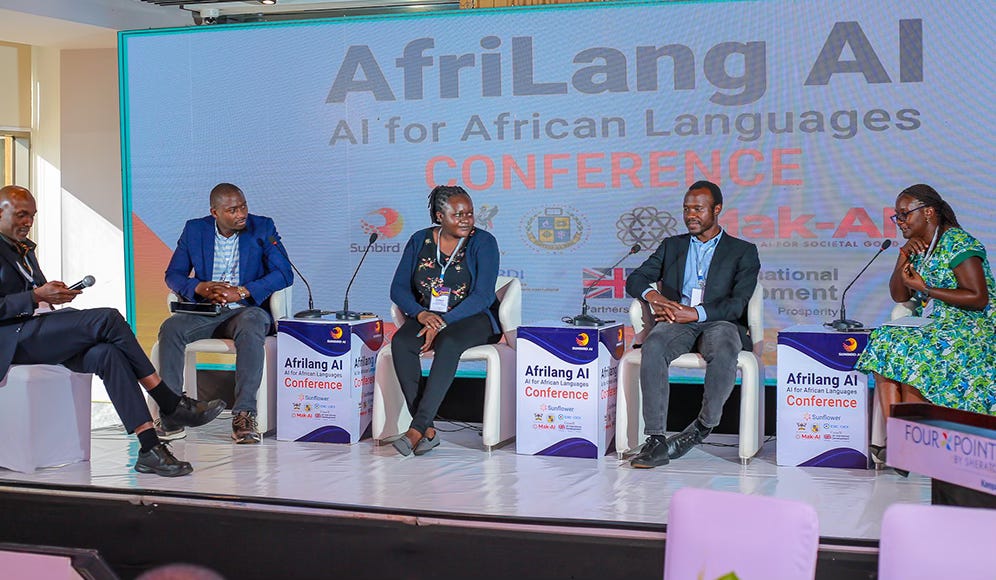
Uganda hosts AI for African languages conference; launches Sunflower
#Uganda #education — Makerere University’s AI for African Languages Conference unveiled Sunflower, a multilingual large language model that understands 30+ Ugandan languages. The event, led by Makerere Centre for Artificial Intelligence with IDRC and FCDO support, prioritised data collection, ASR and ethical, community-led language technology. Mak-AI
NaMaqal: Somali speech-to-text aids humanitarian response
#Somalia #applications — NaMaqal, a Somali speech-to-text system, improves humanitarian operations by converting Somali audio into text to help agencies index, translate and analyse local communications. The tool supports crisis response, documentation and information access where Somali dialects and limited resources have previously restricted automated language coverage. (TechCabal)
Policy
South Africa’s science minister warns of ethical risks as AI shapes conflict and journalism
#SouthAfrica #policy — Blade Nzimande, South Africa’s Minister of Science, Technology and Innovation, urged vigilance over emerging technologies at the World Conference of Science Journalists in Pretoria, warning that AI is being misused in conflict and against journalists. The theme of the conference was “Science journalism and social justice: journalism that builds understanding and resilience.” (iAfrica)
Beyond the AI hype: what’s happening inside Africa’s classrooms
#Africa #education — More than 70% of surveyed teachers are already using generative tools for lesson planning and content creation, argues researcher Sachi Satapathy, using it as a tutor in under-resourced classrooms. But teachers are concerned about fairness and inclusive national policy: 85% of respondents note a catastrophic inequality introduced by the digital divide. (Daily Maverick)
Smart Africa forms inaugural Africa AI Council
#Africa #policy — Smart Africa’s Board has announced the board of the Africa AI Council to coordinate continental AI efforts, steer capacity building, and advise on governance and investment to accelerate Africa’s digital transformation. This comes ten months after the AI Council was announced, and, alongside a number of senior African political leaders, is heavily stacked with tech multinationals, suggesting it being something of a lobbying vehicle. (Smart Africa)
Nigeria moves toward formal AI regulation with new oversight bill
#Nigeria #policy — After an announcement of legislation that would set rules for AI deployment last month, the actual content has come into focus, including a provision that would require mandatory registration and licensing for anyone developing or deploying AI systems in the country. (iAfrica.com)
Events
(Past) Zambia advances AI strategy with national conference
#Zambia #policy — IndabaX Zambia convened policymakers, researchers and industry in Lusaka to advance the National AI Strategy (2024–2026), which rests on six pillars including policy, human capital and infrastructure. The government aims to lift STEM participation from 23% to 40% by 2030, expand internet access to 75% and scale sectoral AI use in health, mining and agriculture. (TechAfrica News)
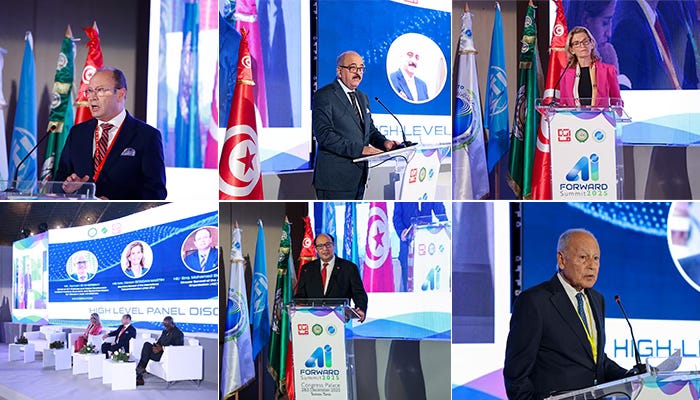
(Past) AI-Forward Summit 2025 in Tunis
#Tunisia #events — The AICTO-backed AI-Forward Summit 2025 took place in Tunis from 30 November to 2 December, gathering ministers, academics and industry leaders to discuss governance, talent and scaling AI across Africa. The programme included panels, workshops and networking aimed at policy, research collaboration and private-sector adoption. (AICTO)
[ This newsletter was human heaved and AI hoed ]