

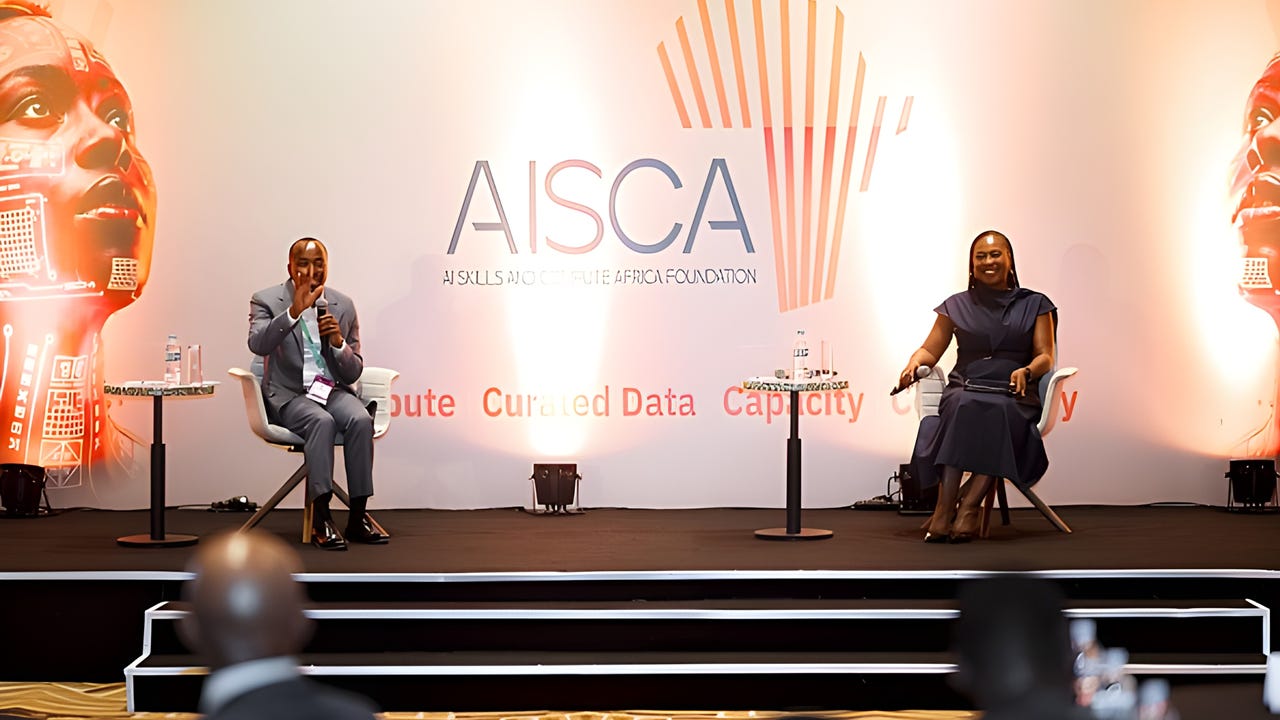
#Africa #AI #Skills — The AI Skills and Compute Africa Foundation (AISCA Foundation), backed by seed funding from pan-African technology group Cassava Technologies, has officially with a mission to dismantle the barriers blocking African participation in AI: compute access, skills development, contextualised data, and ecosystem coordination. Announced in Kigali this week, the Foundation targets one million youth transitioned into AI-related economic opportunities, 25,000 AI-native innovators awarded compute grants, and 10,000 AI researchers supported with compute access and technical assistance. AISCA launches with ambitious goals to ensure that African AI innovation is developed locally, on African infrastructure and is rooted in African priorities.
SO WHAT? — Africa’s AI challenge is not a shortage of talent or ideas, it is a shortage of access. In particular, access to compute infrastructure, but also to relevant datasets, ecosystem support, and to scalable economic pathways for the people building solutions. Without local compute, African researchers send their data offshore, surrendering sovereignty and adding cost. Meanwhile, without high-quality curated African datasets, AI models built elsewhere fail to address local agricultural, health, and climate realities. AISCA Foundation takes aim at those formidable and interconnected gaps.
KEY POINTS:
AISCA Foundation was launched this week, with a mission to provide equitable access to compute infrastructure, AI skills development, research support, and community building across Africa. Backed by seed funding from pan-African technology group Cassava Technologies, the Foundation is headquartered in Kigali, Rwanda.
The Foundation’s targets are ambitious. AISCA aims to transition one million youth into dignified economic opportunities across the AI value chain, award compute grants to 25,000 AI-native innovators building local solutions, and provide compute grants and technical assistance to 10,000 AI researchers advancing cutting-edge work from within the continent.
The new foundation plans to structure its work across four pillars:
Sovereign compute - in partnership with Cassava Technologies, AISCA will provide localised AI infrastructure ensuring that data and processing never leave African borders, directly addressing the data sovereignty concerns that arise when African researchers rely on foreign cloud infrastructure.
Curated African data - AISCA will develop high-quality African datasets in sectors including agriculture, health, and climate. These are all areas where globally trained AI models frequently fail to reflect local realities, limiting their practical value for African communities and governments.
Capacity building - The Foundation is designed to create scalable pathways from foundational AI literacy through to research-grade capability, with a pan-African community network to identify, mentor, and anchor top-tier technical talent across the continent.
Community - AISCA will work across universities, venture ecosystems, governments, development agencies, and private sector partners to ensure AI innovation is grounded in African priorities and accessible to local builders — a deliberately cross-sector model designed to avoid the fragmentation that has weakened previous continental digital initiatives.
Cassava Technologies has already invested millions of dollars in AI infrastructure across Africa. Its support for AISCA could convert that infrastructure investment into a vehicle for broad access, opening compute capacity to researchers and innovators who could not otherwise afford it.
The AISCA announcement also bolsters Rwanda’s positioning as an up-and-coming digital hub.
ZOOM OUT — Africa has the fastest-growing developer community in the world, expanding at 21 percent annually, with an estimated 4.7 million developers already active across the continent spanning professional engineers, students, and self-taught builders. AI is projected to add over $1 trillion to Africa's economy by 2030 and could boost continental GDP growth by 10 to 15 percent, creating hundreds of millions of jobs in the process. Yet annual AI investment across the entire continent stands at just $2 to $3 billion (barely 1% of global spending). Closing the gap between that future potential and current investment levels is likely to remain the central challenge of African AI development for some time.
[Written and edited with the assistance of AI]