#Tunisia #adooption - Just 7.8 percent of Tunisian companies have the balanced digital and organisational strength needed to make artificial intelligence pay off, according to a new study from Tunis-based state economic think tank ITCEQ (Tunisian Institute of Competitiveness and Quantitative Studies). The report, drawn from a survey of 1,208 firms already engaged in digital transformation, finds 86 percent of companies believe new technology drives innovation, yet only 19 percent have actually innovated. Budget restrictions and a digital skills gap remain the biggest barriers standing in the way.
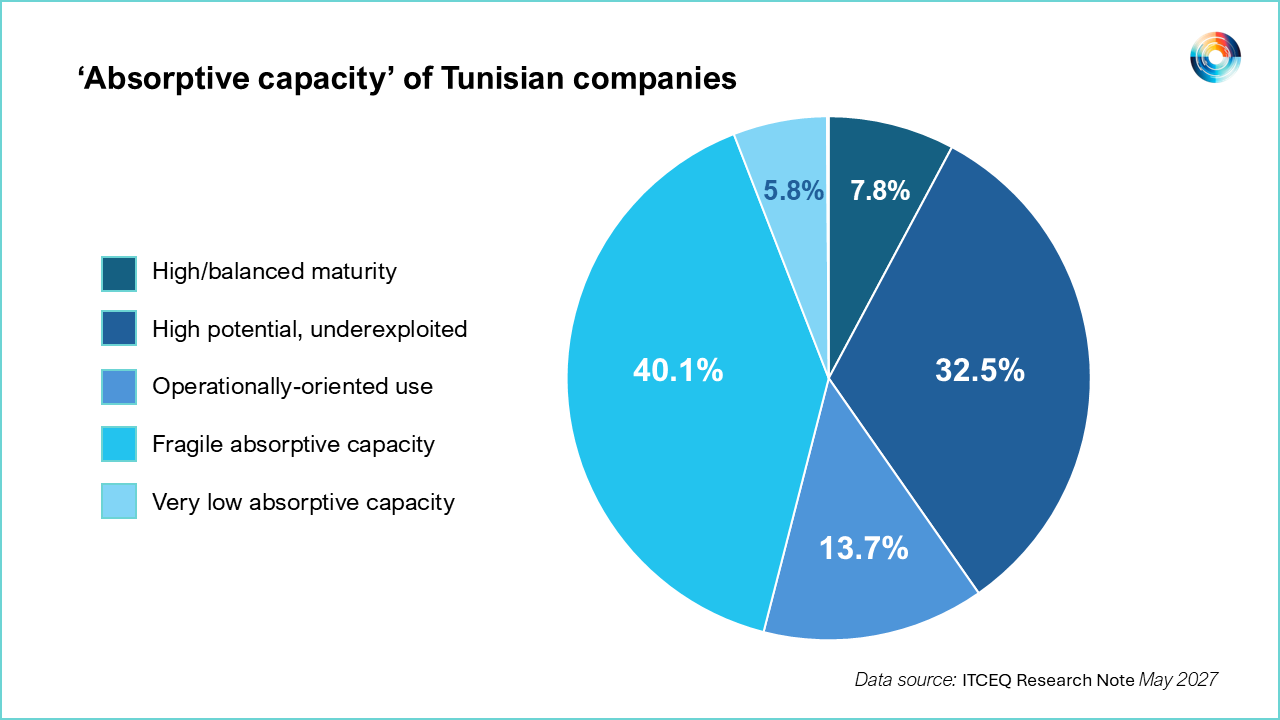
SO WHAT? - The findings challenge the idea that AI adoption is mainly a matter of buying the right software. ITCEQ’s data show artificial intelligence only delivers results in firms that have already built the organisational habits, staff readiness and knowledge-sharing routines needed to absorb it. With 40 percent of surveyed companies sitting in a “fragile absorptive capacity” cluster, most Tunisian businesses risk investing in AI tools they aren’t yet equipped to use well. This can be expected to provide a persistent challenge to the government as it endeavours to drive national adoption of AI and other advanced technologies.
KEY POINTS:
ITCEQ (Tunisian Institute of Competitiveness and Quantitative Studies) surveyed 1,208 Tunisian companies already digitalising or planning to digitise. The digital transformation report sorts companies into five profiles by “absorptive capacity” — the ability to acquire, assimilate, transform and exploit new technology, based on a framework first developed by economists Cohen and Levinthal in 1990.
The key finding of the report is that only 7.8% of firms fall into the top-performing cluster, showing strong, balanced scores across acquisition, assimilation, transformation and exploitation of technology. This is the profile most likely to invest seriously in AI, Big Data and cloud tools.
However, the largest group, 40.1% of firms, has “fragile absorptive capacity”: patchy digital routines that don’t combine into a coherent process, a profile ITCEQ describes as unsustainable over the medium term.
32.5% of companies sit in a “high potential, low realisation” cluster, meaning they acquire and assimilate technology reasonably well but fail to convert it into new products, processes or revenue.
Basic digital infrastructure is fairly widespread: 76.2% of firms have a website, 72.5% use core digital management tools such as ERP or accounting software, and 60% use collaborative platforms.
Digitalisation is uneven across business functions, running highest in administrative management (66%) and production and sales (62%), but falling to just 43% in information-systems management, the weakest link for most firms.
Financial constraints (cited by 70.9% of firms) and a shortage of digital skills (63.3%) are the two biggest barriers blocking companies from turning technology investment into real innovation.
Just 11% of surveyed companies use public R&D incentives, pointing to weak take-up of government schemes designed to help firms fund research and technology projects.
The report sets out three possible AI adoption paths: a step-by-step route that digitalises first, a faster AI-led route that only works for already-mature firms, and a blended path combining both, which ITCEQ recommends for most companies.
ITCEQ’s analysis validated the five-cluster typology with 93% classification accuracy, confirming that firms with the strongest AI uptake also report the highest staff readiness for change.
[Written and edited with the assistance of AI]
Source: ITCEQ
DOWNLOAD