
Ghana launches AI strategy, with vision for AI-powered society
Accra launches AI strategy targeting 500 billion cedis GDP contribution by 2035

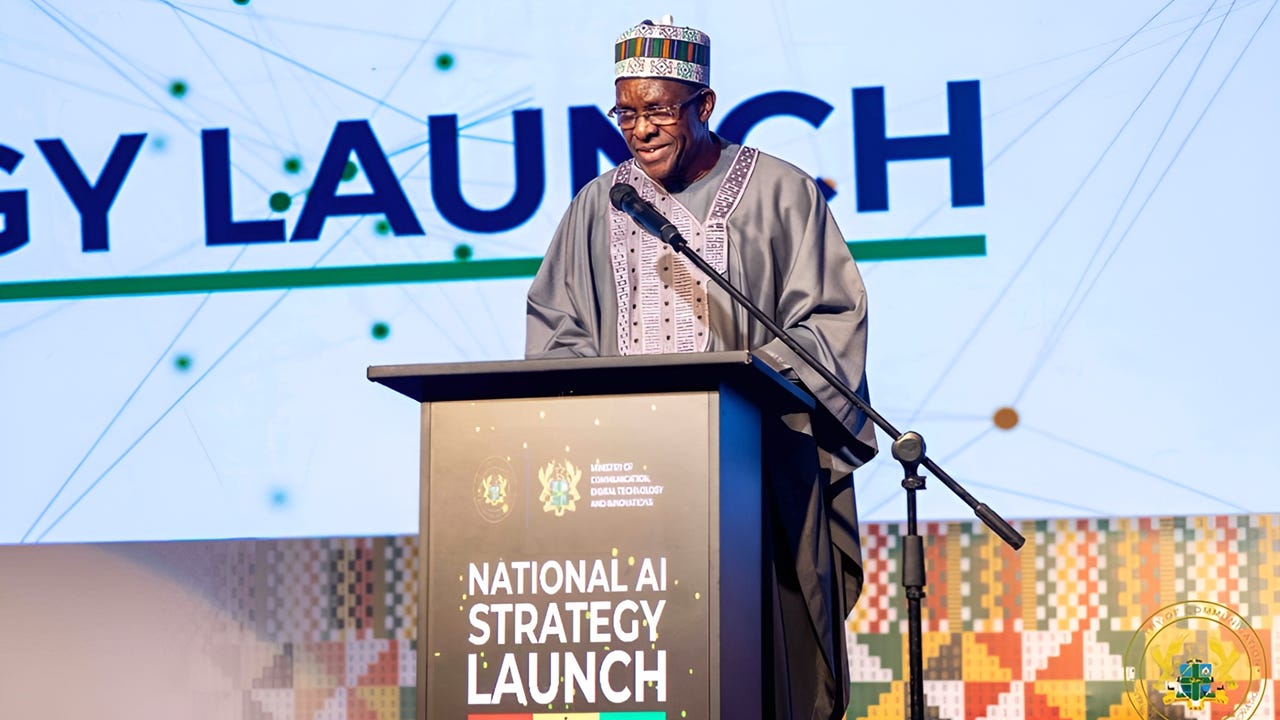
#Ghana #AIStrategy — President John Dramani Mahama has launched Ghana’s first National Artificial Intelligence Strategy in Accra, setting out a vision for Ghana to become a leading African AI hub with a AI-powered society by 2035. Developed by the Ministry of Communication, Digital Technology and Innovations with support from GIZ FAIR Forward, the British FCDO, UNDP, UNESCO and the KNUST Responsible AI Lab (RAIL), the strategy is built around eight pillars covering education, youth employment, infrastructure, data governance, ecosystem development, sector adoption, applied research and public sector AI. A National AI Fund starting at 5 billion Ghanaian cedis ($450m) will seed implementation, while the government plans to attract a total of 200 billion cedis ($18b) in local and foreign direct investment by 2035.
SO WHAT? — Ghana’s bold new National AI Strategy (2025-2035) makes a deliberate choice to aim to be a producer of AI, not simply a consumer. President Mahama’s call to build sovereign AI that understands local languages, reflects Ghanaian culture and solves Ghanaian problems to empower Ghanaian society. The strategy’s economic goal is also ambitious, targeting a 500 billion cedi ($45b) GDP contribution from AI by 2035. AI coordinators will be appointed across every ministry, and a Responsible AI Authority will be established within the first year of stratgey implementation.
KEY POINTS:
Ghana has launched its first National AI Strategy (2025-2035), built around a mission to harness AI for inclusive growth across all sectors and position Ghana as a leading African AI hub by 2035. The strategy was launched by President John Dramani Mahama at a high-level event in Accra on 24 April 2026.
Other speakers at the launch event included Hon. Samuel Nartey George, Minister for Communication, Digital Technology and Innovations; and Rt. Hon. Alban Sumana Kingsford Bagbin, Speaker of Parliament.
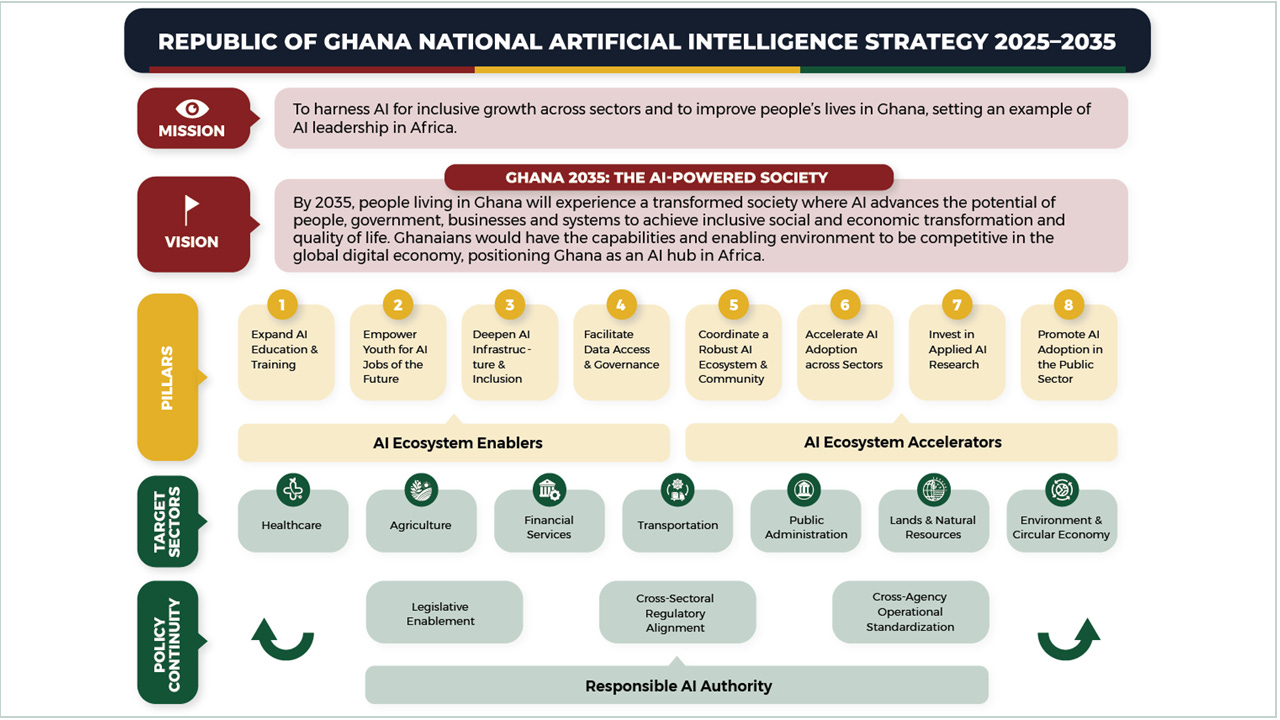
The new National AI Strategy is structured around eight pillars:
expanding AI education and training,
empowering youth for AI jobs,
deepening digital infrastructure and inclusion,
facilitating data access and governance,
coordinating a robust AI ecosystem,
accelerating AI adoption across sectors,
investing in applied AI research, and
promoting AI adoption in the public sector.
A National AI Fund will be established with an initial 5 billion Ghanaian cedis ($450m) over five years to 2030, scaling to a 15 billion cedi ($1.4b) fund from 2030 to 2035. The strategy targets 200 billion cedis ($18n) in total foreign and local private sector investment to grow Ghana’s AI ecosystem by 2035.
AI is targeted to contribute 200 billion Ghanaian cedis to GDP by 2030 and 500 billion cedis ($45b) by 2035, with the strategy framing AI as a national development pathway spanning governance, education, health, agriculture and the broader economy.
Every ministry will designate an AI focal person to drive implementation across the public service, following a Cabinet AI Bootcamp held under the Chief of Staff’s leadership. The preparatory step already seems to have shifted AI from a technical issue to a government-wide strategic priority.
The strategy proposes GhanaChat, a large language model to be trained on data from government agencies and arms of government, for internal government use. The sovereign AI chatbot platform will be designed to boost productivity, while preventing civil servants from transmitting confidential information overseas.
Ghana plans to establish a Responsible AI Authority within the first year, modelled on Singapore’s National AI Office, the Egypt National AI Council and the UK’s Office for AI. The authority will coordinate institutional stakeholders, oversee implementation and lead ongoing monitoring and evaluation.
The strategy includes a target of curating 1 trillion tokens worth of Ghanaian datasets by 2030, with grants proposed for the creation and annotation of datasets across health, agriculture and education. The target will form part of a deliberate effort to build AI on locally grounded data rather than imported training sets.
Key development partners in the strategy include GIZ FAIR Forward, the British FCDO, UNDP, UNESCO and the KNUST Responsible AI Lab (RAIL). Ghana is also working with UNESCO and the European Commission to implement the AI Readiness Assessment Methodology through a national multi-stakeholder process.
The strategy also calls for the creation of 10 Ghanaian AI unicorns and a privately funded Ghanaian AGI lab competing globally, ambitions that frame the strategy not merely as a digital governance exercise but as an economic competitiveness agenda setting long-term commercial targets.
ZOOM OUT — The strategy launch follows a significant infrastructure announcement made earlier this month. Ghana's Cabinet recently approved plans for a $250 million national AI computing centre, announced by Communications Minister Samuel Nartey George at a national stakeholder engagement on Ghana's AI Readiness Assessment. The computing centre will support AI research, development and deployment across agriculture, healthcare, education and financial services. Ghana already ranks third in Africa for AI readiness and sits at the geographic and institutional centre of the African Continental Free Trade Area.
[Written and edited with the assistance of AI]
DOWNLOAD
Read more about African national AI strategies:
Mauritius launches new National AI Strategy (Africa AI News)
Ghana approves $250M AI Hub & National AI Strategy (Africa AI News)
Zimbabwe to put AI at the heart of its economy (Africa AI News)
New ‘AI Made in Morocco’ strategy (Middle East AI News)
AI stakeholders advance Algeria’s national strategy (Middle East AI News)