
Kenya publishes draft AI policy for public consultation
Policy built on nine pillars, public has until 4 August to submit comments


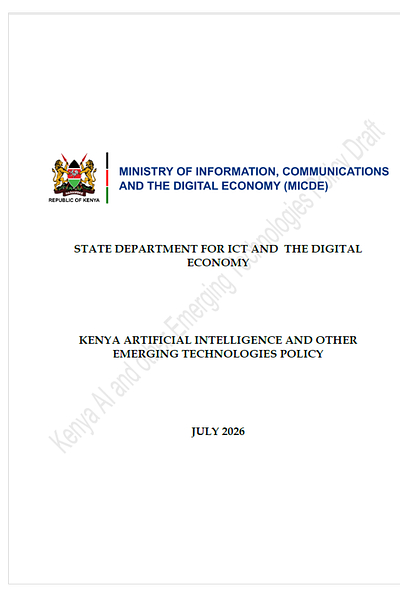
#Kenya #policy - Kenya’s Ministry of Information, Communications and the Digital Economy has opened public participation on the Draft Artificial Intelligence and Other Emerging Technologies Policy, 2026, with Kenya’s State Department for Parliamentary Affairs issuing the call this week. The draft policy proposes a national framework covering governance, development, deployment and use of AI across all sectors, including a new National AI and other Emerging Technologies Council, The council is to be led by an AI and other Emerging Technologies Director supported by a Governing Board, a Technical Advisory Forum and five specialised Directorates responsible for different areas of governance. Written public submissions for the consultation are due by 4 August 2026 (twelve days from the announcement).
SO WHAT? - Kenya has moved quite fast on AI governance this year, from a Senate-ordered directive to draft a national policy, to a Cabinet Standing Committee on AI formed earlier this month. The Draft Artificial Intelligence and Other Emerging Technologies Policy is shared for public consultation, four months after the Senate requested the policy. However, the new policy doesn’t reference the Senate bill and doesn’t seem to seek alignment with it. Among other things, the Senate bill proposes an Office of the Artificial Intelligence Commissioner that would investigate complaints and enforce powers. According to the draft policy, this responsibility is included under the broader remit of the National AI and other Emerging Technologies Council.
KEY POINTS:
The Draft Artificial Intelligence and Other Emerging Technologies Policy, 2026, was developed by a multi-stakeholder committee and published online this week by Kenya’s Ministry of Information, Communications and the Digital Economy.
The policy aims to establish the formation of a National AI and other Emerging Technologies Council as the central regulatory authority for AI and other Emerging Technologies. The council will be led by an AI and other Emerging Technologies Director supported by a Governing Board, a Technical Advisory Forum and five Directorates (Policy & Standards; Compliance & Risk; Regulatory Sandbox; Advisory and Capacity Building; and Safety and Security).
The new AI policy introduces classification of AI systems by risk level, mandatory registration for high-risk applications, and regulatory sandboxes intended to balance innovation with safety.
The Draft Artificial Intelligence and Other Emerging Technologies Policy is structured around nine pillars:
Research, Innovation and Commercialization Ecosystem Development;
Sectoral Applications of AI and other Emerging Technologies;
Capacity and Human Capital Development;
Environmental Sustainability and Green Intelligence;
Governance, Legal and Regulatory Frameworks;
Data Ecosystem Management;
Ethics, Safety, Security and Inclusion;
Infrastructure and Digital Readiness; and
Sovereignty and Strategic Autonomy.
The new policy builds on Kenya’s existing AI Strategy (2025-2030), the Digital Master Plan (2022-2032) and the Data Protection Act (2019), while aiming to close coordination gaps identified in stakeholder consultations.
The policy is framed as supporting Kenya’s Bottom-Up Economic Transformation Agenda (BETA), positioning AI as a driver of inclusive growth and productivity.
The draft policy appears to diverge from the Artificial Intelligence Bill 2026, introduced in the Senate in March 2026, which proposed a differently structured Office of the AI Commissioner with its own investigation, penalty and sandbox powers. These responsibilities are covered in the policy under the National AI and other Emerging Technologies Council.
Among other things, the March Bill, proposed fines of up to KES 5 million (roughly $40,000) and prison terms of up to two years for creating or distributing harmful AI-generated content.
Public comments and memoranda regarding the Draft Artificial Intelligence and Other Emerging Technologies Policy must be submitted via email or delivered physically to the Committee on AI and Other Emerging Technologies in Nairobi, by 4 August 2026.
ZOOM OUT - Kenya launched the AI Strategy this policy builds on in March 2025, unveiled by Cabinet Secretary William Kabogo Gitau. Built around three pillars, AI digital infrastructure, data and AI governance, and research and commercialisation, it set out to develop localised AI models for sectors like agriculture, healthcare and education, back. The national strategy was developed with the support of the EU, Germany’s Federal Ministry for Economic Cooperation and Development, Canada’s International Development Research Centre and the UK’s Foreign, Commonwealth & Development Office.
Artificial intelligence is forecast to add up to $2.4 billion to Kenya's economy by 2030, while its ICT market is expected to grow from $11.19 billion in 2025 to $14.92 billion by 2030. With the national AI strategy already in implementation, many in Kenya’s government wants to see a strong governance framework in place, before the sector scales further and gaps may become harder to close.
[Written and edited with the assistance of AI]
Source: Ministry of ICDE
DOWNLOAD
LINK
Call for public participation (MICDE website)
Read more about Kenya’s AI policymaking:
Kenya Cabinet forms committee to drive national AI strategy (Africa AI News)
Kenya’s Senate orders new AI policy following new AI bill (Africa AI News)
Kenya launches ambitious AI roadmap for digital future (Africa AI News)
Kenya grants just 5 days for feedback on AI strategy (Africa AI News)